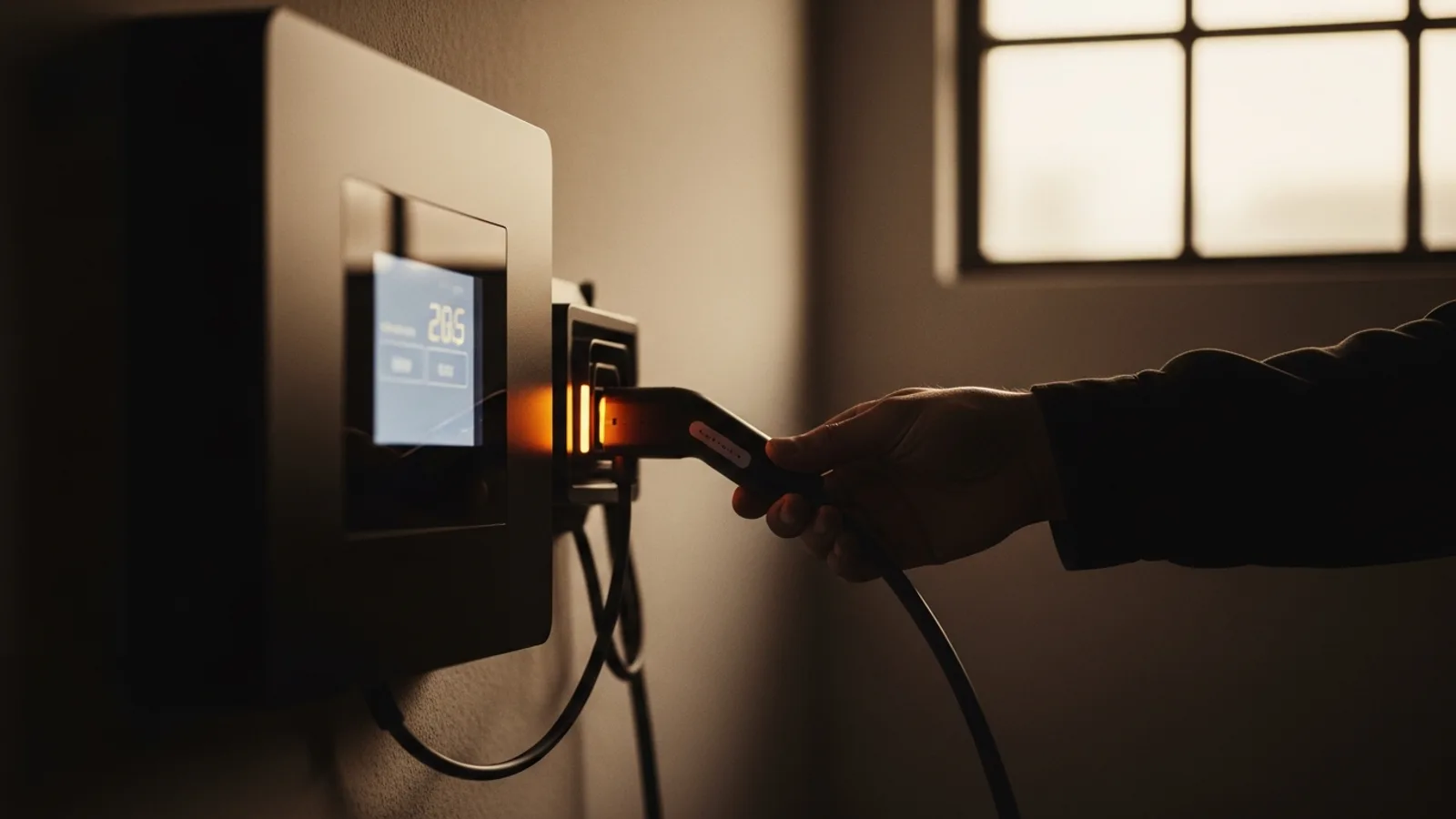
EV Charging Speed: Why Is My EV Charging Slower Than Expected?
By EV Charger Directory Editorial Team
Independent EV charging research desk
Our editors research grants, hardware and installation practice across the UK, Germany and the Netherlands. We don't sell chargers or take installer commissions — the guides are funded by advertising, so the advice stays independent.
Updated: 27 June 2026
Your wallbox is rated 7 kW (UK) or 11 kW (Germany and the Netherlands), but the app shows the car sipping 3.6. Nothing is broken. In most cases the charger is doing exactly what it's allowed to, and the limit lives somewhere else entirely — usually in the car, occasionally in the weather, sometimes in the way your home shares power.
A wallbox is, in plain terms, a clever switch. It offers power; the car decides how much to take. So when charging is slower than the number on the box, the question isn't 'what's wrong with the charger' but 'what's capping the rate'. There are five usual suspects.
1. The car's onboard charger is the real ceiling
Every EV has an onboard AC charger, and its rating — not the wallbox — sets your home charging speed. Plenty of cars top out at 7.4 kW on AC even when plugged into an 11 kW or 22 kW unit. Some plug-in hybrids cap at 3.6 kW. A few EVs accept the full 11 kW; very few accept 22 kW on AC at all.
If your car's onboard charger is single-phase 7.4 kW, an 11 kW wallbox will never push it past that. The box isn't underperforming — the car simply won't take more.
2. Single-phase versus three-phase
This is the big structural one, and it splits by country.
- UK homes are usually single-phase. That caps a domestic AC charge at around 7.4 kW, which is why 7 kW is the British norm.
- German and Dutch homes often have three-phase supply, which is why 11 kW is standard there.
Here's the catch: a three-phase 11 kW wallbox feeding a car that only charges on one phase delivers a third of the power. The hardware on the wall is three-phase; the car's onboard charger isn't. Mismatch, and you get the single-phase rate.
3. Cold (and very hot) batteries charge slowly
Batteries have a comfort zone. On a frosty morning, the car may deliberately hold back AC charging to protect a cold pack, then speed up as it warms. The effect is milder on home AC than on rapid DC, but on a 0°C night you'll still notice it. Heat does the opposite at the extreme — a battery that's already hot from a long drive may taper to protect itself.
4. The charge curve and a near-full battery
EVs don't charge at a flat rate. As the battery fills, the car eases off — gently on AC, dramatically on DC rapid charging. The last 10–20% is always the slowest stretch. If you keep checking the rate when the car is near full and despairing, that taper is normal and deliberate. It protects battery life.
5. Load balancing is sharing your power
If your home has load balancing (also called dynamic load management), the charger intelligently throttles itself when other big appliances are running — the oven, a heat pump, a second EV. That's a feature, not a fault: it stops your main fuse tripping. When the kettle goes off, the charge rate climbs back up. Two chargers on one supply will share the available headroom the same way.
Quick reference: what limits AC charging
| Factor | Typical effect | Can you change it? |
|---|---|---|
| Onboard charger rating | Hard ceiling (often 7.4 kW) | No — it's built into the car |
| Single vs three-phase | Single-phase caps ~7.4 kW | Only with a supply upgrade |
| Battery temperature | Slower when cold or very hot | Precondition before charging |
| State of charge | Tapers near full | Normal; charge to 80% on AC |
| Load balancing | Throttles when home demand is high | By design; eases off later |
So is anything actually wrong?
Usually not. The honest test: work out your car's maximum AC rate, then check whether your supply (single or three-phase) and the wallbox can match it. If all three line up and you're still seeing a fraction of that with a warm battery and a half-full pack, then it's worth a look. A certified installer can read the charger log and confirm whether load balancing, a phase issue or the supply is capping you. You'll find local, certified installers throughout our directory.
Frequently asked questions
- Why does my 11 kW wallbox only charge my car at 3.7 kW?
- Almost always because your car charges on a single phase. An 11 kW wallbox is three-phase, but if the car's onboard charger only uses one phase it draws about a third of that — roughly 3.7 kW. The limit is in the car, not the wallbox.
- Does my EV charge slower in winter?
- It can. A cold battery accepts power more slowly while it warms up, so an early-morning charge in freezing weather may start gently and speed up. The effect is smaller on home AC than on rapid DC charging, but it is real. Preconditioning the car before charging helps.
- Why does charging slow down when the battery is nearly full?
- EVs deliberately taper the charge rate as the battery fills, easing off over the last 10–20%. This protects battery health and is completely normal. For daily use on AC, charging to about 80% keeps speeds higher and is kinder to the pack.
- Is load balancing making my charger slower?
- It can, and on purpose. Load balancing throttles the charger when other big appliances are drawing power so your main fuse doesn't trip. Once that demand drops, the charge rate climbs back up. It's a safety feature, not a fault.