EV Charger Compatibility: Which Chargers Work With My Car?
By EV Charger Directory Editorial Team
Independent EV charging research desk
Our editors research grants, hardware and installation practice across the UK, Germany and the Netherlands. We don't sell chargers or take installer commissions — the guides are funded by advertising, so the advice stays independent.
Updated: 27 June 2026
Here's the reassuring part, up front: if you buy a modern home wallbox in the UK, Germany or the Netherlands, it will work with your electric car. Full stop. The anxiety people feel in the showroom — "but is it compatible?" — is mostly misplaced. Petrol-era thinking, where the wrong nozzle simply doesn't fit, doesn't map onto home charging. The honest question isn't whether a charger works with your car. It's how fast it charges, and that answer lives inside your car, not the box on the wall.
Let's unpack why.
AC and DC: the split that explains everything
Your home wallbox delivers alternating current (AC). The motorway rapid charger delivers direct current (DC). That single distinction explains nearly every compatibility question people have.
A battery can only store DC. So somewhere, AC has to be converted. At home, the conversion happens inside the car, by a component called the onboard charger. At a rapid charger, the conversion happens in the unit itself, which is why those machines are the size of a fridge and cost tens of thousands.
This is the key thing to grasp: your home charger isn't really "charging" the battery directly. It's feeding AC power to your car, and your car's onboard charger does the actual work. Which means your car — not your wallbox — sets the ceiling on home charging speed.
Connector standards, and why they've stopped being a worry
A decade ago, plug standards were a genuine mess. They've since converged hard. In all three of our markets, the picture is now refreshingly simple.
| Connector / standard | Current | Where you meet it | Status |
|---|---|---|---|
| Type 2 (Mennekes) | AC | Home wallboxes, most public AC points | The European standard — universal |
| CCS (Combo 2) | DC | Motorway and rapid chargers | The European DC standard |
| CHAdeMO | DC | Older rapids; a few Nissan/older Asian EVs | Legacy, being phased out |
| Type 1 (J1772) | AC | A handful of pre-2018 imports | Effectively obsolete here |
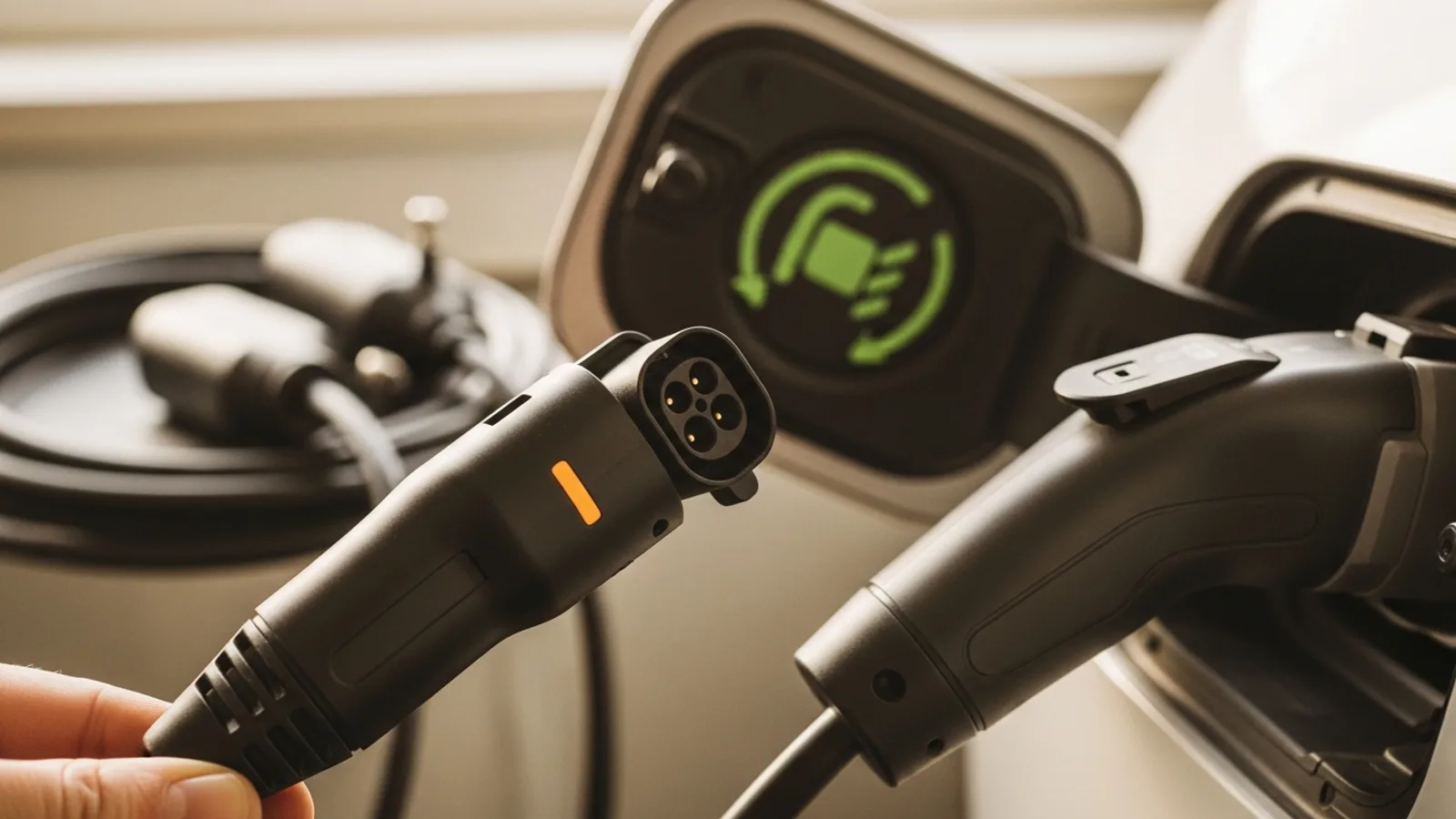
For home charging, only one row matters: Type 2. Every mainstream EV sold in Europe since around 2018 has a Type 2 inlet for AC charging, and every home wallbox uses a Type 2 connector. They are designed to fit each other. This includes Tesla — in Europe, Teslas use Type 2 for AC and CCS for rapid DC, just like everyone else. The old US-style proprietary plug doesn't apply here.
CHAdeMO is the one fading standard worth knowing about. If you drive an older Nissan Leaf, your rapid-charging port may be CHAdeMO, and those connectors are slowly disappearing from new charging sites. But that only affects rapid charging on the road — your home AC charging is still plain Type 2.
The real ceiling: your car's onboard charger
This is where the genuinely useful nuance lives. Two cars plugged into the same 11 kW wallbox can charge at completely different speeds — because their onboard chargers differ.
- A car with a 7.4 kW single-phase onboard charger will draw 7.4 kW even from a 22 kW wallbox.
- A car with an 11 kW three-phase onboard charger will use the full 11 kW.
- A car limited to 3.7 kW (some plug-in hybrids) charges slowly no matter what you bolt to the wall.
The wallbox can only offer power. The car decides how much it accepts. Paying for a 22 kW unit to charge a car capped at 7.4 kW buys you nothing — the extra capacity sits idle.
This interacts with your home's electricity supply, and that's where the three countries diverge. UK homes are typically single-phase, so 7 kW is the practical home norm regardless of what your car could theoretically take. German and Dutch homes far more often have three-phase supply, so 11 kW is the everyday norm there. A German-market car with an 11 kW onboard charger will quietly charge at 7 kW if you move it to a single-phase British house — same car, same cable, slower fill, purely because of the supply.
Tethered or untethered: a convenience choice, not a compatibility one
Wallboxes come two ways. A tethered unit has the cable permanently attached. An untethered (or "socketed") unit has just a Type 2 socket, and you supply your own cable. Both are fully compatible with any Type 2 car. The trade-offs:
- Tethered — grab and plug, no fishing a cable out of the boot. Slightly less tidy, and you're committed to that connector type.
- Untethered — neater on the wall, future-proof if standards ever shift, and you can use a longer cable. One extra step each time.
There's no "wrong" answer, and neither affects whether your car charges. It's purely about daily handling.
Smart charging and the app question
Modern wallboxes are computers with a plug. They talk to apps for scheduling, solar matching and cheaper overnight tariffs. Here compatibility can matter — but between the charger and the software, not the charger and the car.
Look for OCPP (Open Charge Point Protocol). It's the open standard that lets a charger work with third-party apps and energy tariffs rather than locking you into one manufacturer's ecosystem. A wallbox that speaks OCPP keeps your options open if you switch energy supplier or smart-charging platform later. Your car doesn't care about any of this — it just receives the power the charger decides to send.
How to check your own car in two minutes
Don't guess. Open your car's handbook or the manufacturer's spec page and find two figures:
- The onboard AC charger rating — usually listed as 7.4 kW (single-phase) or 11 kW / 22 kW (three-phase). This is your home-charging ceiling.
- The DC rapid-charge maximum — relevant for motorway stops, not your driveway.
Match the first number against your home supply, and you'll know exactly what speed to expect. If your car tops out at 7.4 kW, an 11 kW wallbox is harmless but pointless overkill; a 7 kW unit does the same job for less.
The takeaway is simple. Compatibility, in practice, is a solved problem — any modern Type 2 wallbox works with any modern EV on sale here. What varies is speed, and speed is set by your car and your supply together. If you'd rather have someone confirm exactly what your home can deliver before you buy, our directory lists certified local installers who'll check your supply and your car's rating, and quote for the unit that actually fits both.
Frequently asked questions
- Will any home wallbox work with my electric car?
- Yes. Every mainstream EV sold in the UK, Germany and the Netherlands since around 2018 uses the Type 2 connector for AC charging, and every modern home wallbox uses Type 2 too. They are built to fit each other. The only thing that varies between cars is charging speed, not whether charging happens.
- Do Teslas use a different charger in Europe?
- No. In Europe, Teslas use Type 2 for home and AC charging and CCS for rapid DC charging — the same standards as every other brand. The proprietary US-style connector doesn't apply here, so a standard Type 2 wallbox charges a Tesla without any adapter.
- Why does my EV charge slower than the wallbox's rated power?
- Because your car's onboard AC charger sets the real ceiling, not the wallbox. A car limited to 7.4 kW will only ever draw 7.4 kW, even from an 11 kW or 22 kW unit. Check your car's onboard charger rating in the handbook to know your true home-charging speed.
- Should I choose a tethered or untethered charger?
- Both are fully compatible with any Type 2 EV, so it's purely about convenience. Tethered means a fixed cable you grab and plug in; untethered gives a tidier wall unit and lets you use your own cable. Neither affects whether or how fast your car charges.
- What is OCPP and does my car need to support it?
- OCPP (Open Charge Point Protocol) is an open standard that lets a smart charger work with third-party apps and energy tariffs rather than locking you into one brand. It matters between the charger and software, not the car — your EV simply receives whatever power the charger sends.