Weatherproofing Outdoor EV Chargers: A Practical Guide
By EV Charger Directory Editorial Team
Independent EV charging research desk
Our editors research grants, hardware and installation practice across the UK, Germany and the Netherlands. We don't sell chargers or take installer commissions — the guides are funded by advertising, so the advice stays independent.
Updated: 27 June 2026
Your home charger spends every day of its life outside — driving rain in November, frost in January, the full glare of a July afternoon. Most people never think about that until a unit starts behaving oddly after its second winter. The reassuring part: a charger that is specified and mounted properly shrugs all of it off for a decade or more. Here is what "properly" actually means.
What an IP rating really tells you
Every outdoor charger carries an IP (Ingress Protection) rating — two digits stamped on the casing or buried in the spec sheet. The first digit covers solids and dust on a scale of 0–6; the second covers water on a scale of 0–9. Higher is better, and the two are independent.
For a wall-mounted home unit, two ratings dominate the market:
| Rating | Dust | Water | Realistic use |
|---|---|---|---|
| IP54 | Protected against settling dust | Splashing from any direction | The sensible minimum for a sheltered wall |
| IP65 | Fully dust-tight | Low-pressure jets from any angle | Exposed gables, coastal sites, pressure-washing nearby |
In practice IP54 is the floor you should accept, and IP65 is what you want if the charger faces open weather, sits low enough to catch splash-back, or lives near where you hose down the car. Don't obsess over chasing IP66 or higher for a domestic unit — it's rarely necessary and you pay for it.
Sun ages a charger faster than rain
Water gets the attention, but ultraviolet light does the quiet damage. Cheap enclosures yellow, go chalky and turn brittle; rubber cable glands harden and crack; a south-facing screen can wash out or overheat. Look for an enclosure described as UV-stabilised or polycarbonate-based, and check the stated operating range — a decent unit handles roughly −25 °C to +40 °C.
Temperature swings matter for the cable too. PVC cable left coiled tight in hard frost can crack when you yank it straight. That's not a fault — it's physics — and it's one more reason cable management is part of weatherproofing, not an afterthought.
Where you mount it matters as much as what you buy
The best enclosure in the world fails if it's bolted in a bad spot. A few rules earn their keep:
- Mount the connector at roughly 90–120 cm off the ground. Comfortable to plug in, and high enough to dodge the splash zone and any standing water or snow.
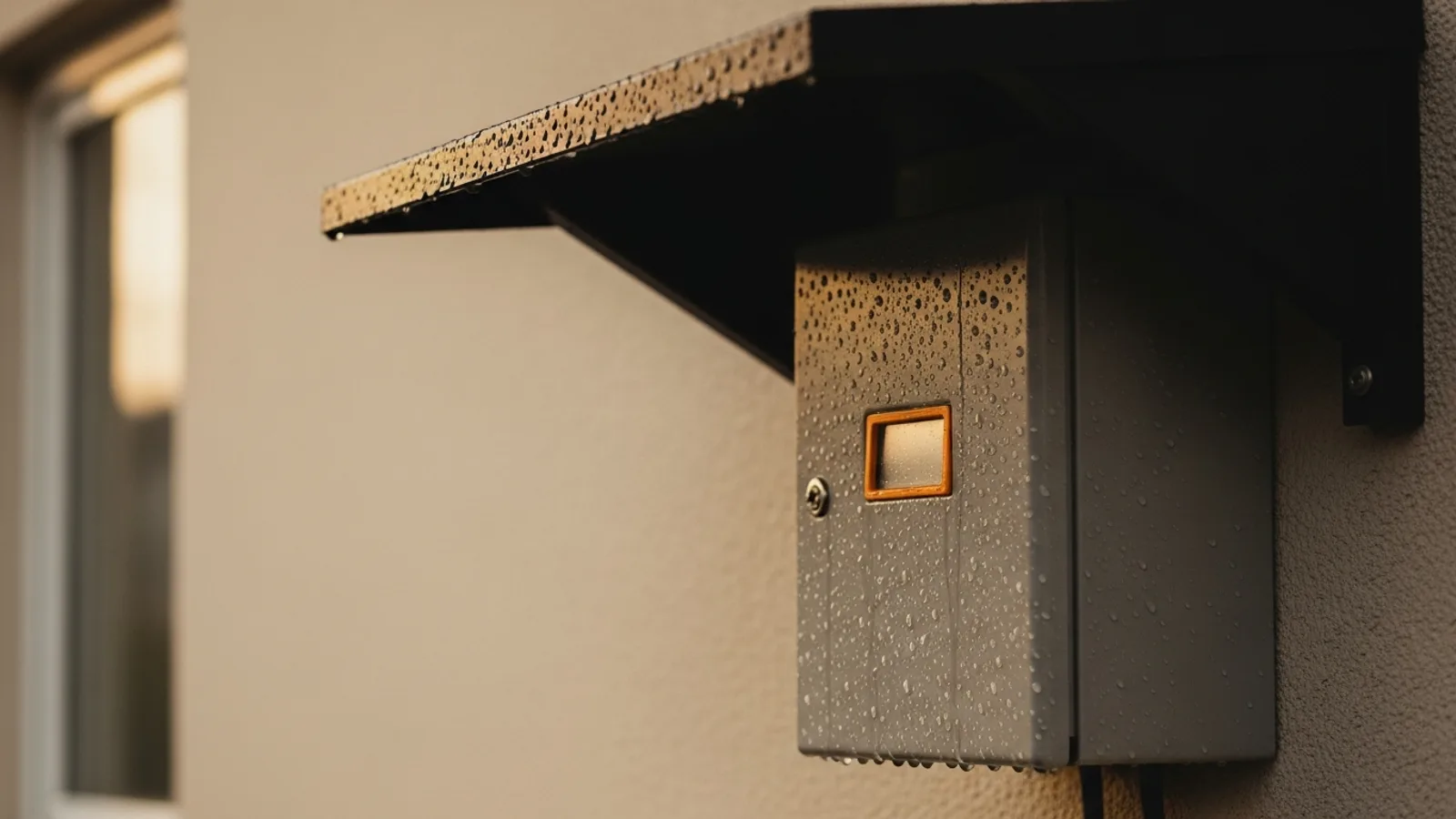
- Use the shelter you already have. Under an eave, a soffit or a porch roof, a charger sees a fraction of the direct rain — and the screen lasts far longer out of the sun.
- Avoid frost pockets and run-off. A wall beneath a leaking gutter or at the bottom of a slope collects water the casing was never meant to sit in.
- Keep it off the floor. Pedestal mounts are fine, but the head and any sockets should never be at ankle height where puddles form.
Cable management is half the battle
The enclosure is sealed at the factory; the cable and connector are where weather actually gets in over time. On a tethered unit, hang the connector in its holster after every charge — never leave it dangling in a puddle or coiled on wet ground, where grit and water work into the contacts. On a socketed unit, fit the supplied dust cap when nothing is plugged in; that little rubber flap is doing real work.
Good installers add a drip loop — a downward dip in the cable before it enters the unit — so water runs off rather than tracking into the housing. They also bring the cable in through a sealed gland at the bottom of the enclosure, never the top, so gravity is on your side.
The part that's genuinely the installer's job
You can choose a well-rated unit and a sensible position; sealing it correctly is electrician's work. Bottom cable entry, properly torqued glands, the right back-plate and weatherproof isolators all matter — and a smear of silicone over a badly fitted gland is exactly the bodge that traps water inside and causes the fault it's meant to prevent.
This is where certification pays off. An installer who does outdoor units every week knows which enclosures survive a coastal winter and which ones don't. Our directory lists certified local installers who fit chargers outdoors as routine — worth a look before you settle on hardware, because the right advice on placement often saves more grief than any single spec on the box.
Frequently asked questions
- What IP rating do I need for an outdoor EV charger?
- IP54 is the sensible minimum for a sheltered wall — it resists dust and splashing from any direction. Choose IP65 for exposed, low-mounted or coastal locations, where the unit also faces low-pressure water jets. Going higher than IP65 is rarely necessary for a home charger.
- Can I leave my EV charger outside all year?
- Yes — outdoor chargers are designed for it, with operating ranges around −25 °C to +40 °C. The key is a UV-stabilised enclosure so sun doesn't make the plastic brittle, plus sensible mounting out of direct splash and run-off. Always holster the connector or fit the dust cap when not charging.
- What height should an outdoor charger be mounted at?
- Aim for the connector at about 90–120 cm above the ground. That's comfortable to reach and high enough to avoid splash-back, puddles and snow. Mounting under an eave or porch roof adds shelter and noticeably extends the life of the screen and casing.
- Does sunlight damage an EV charger?
- Over years, yes. Ultraviolet light yellows and embrittles cheap plastics and can wash out a screen, often doing more harm than rain. A UV-stabilised or polycarbonate enclosure resists it, and mounting in partial shade or under cover helps the unit last.
- How should I look after the charging cable in winter?
- Don't yank a tightly coiled cable straight in hard frost — let it relax first, as cold PVC can crack. Keep the connector in its holster off the ground so grit and water stay out of the contacts, and refit any dust cap on a socketed unit between charges.