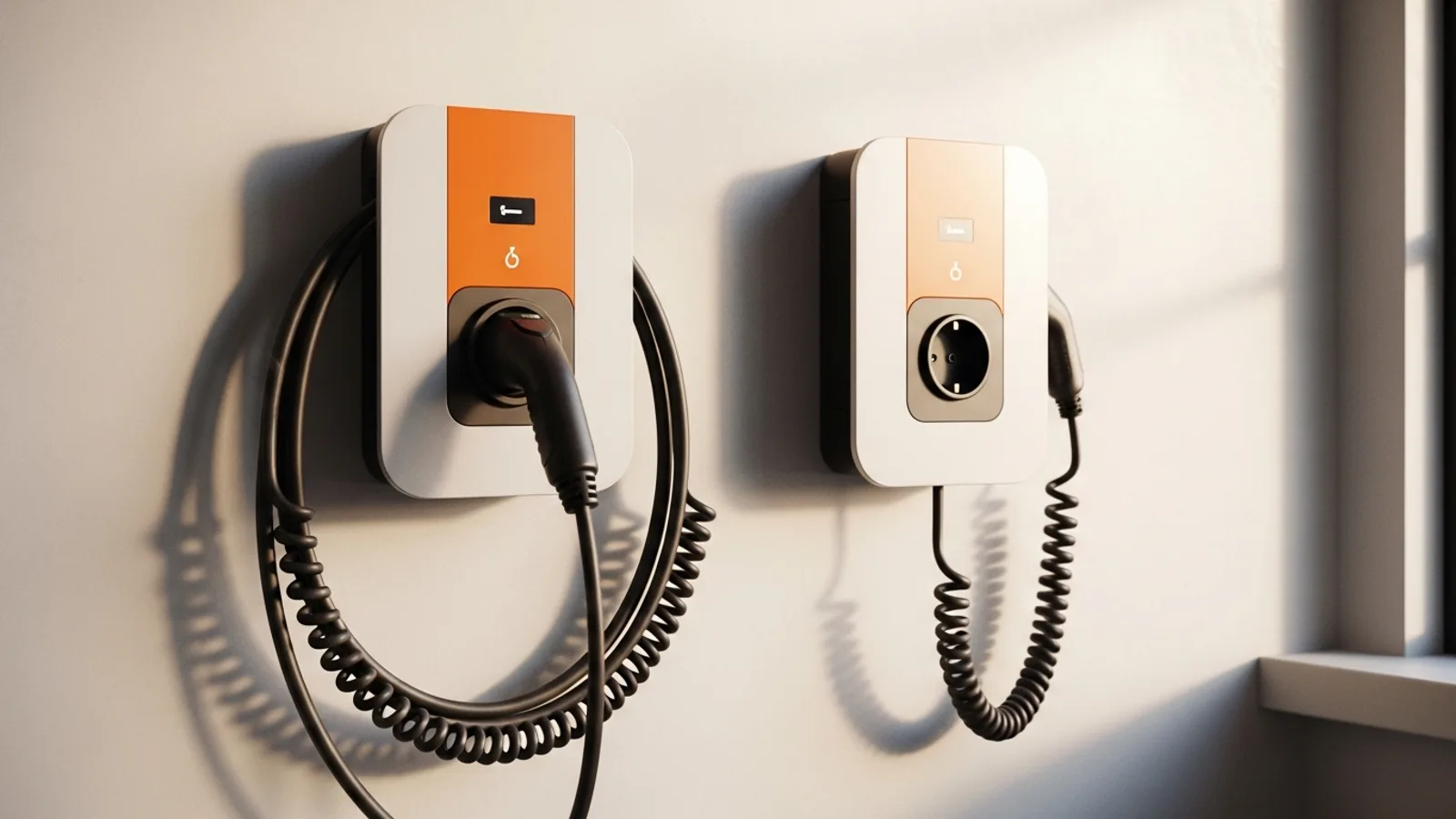
Tethered vs Untethered EV Charger: Pros and Cons
By EV Charger Directory Editorial Team
Independent EV charging research desk
Our editors research grants, hardware and installation practice across the UK, Germany and the Netherlands. We don't sell chargers or take installer commissions — the guides are funded by advertising, so the advice stays independent.
Updated: 27 June 2026
Every home charger splits into two camps, and the dividing line is one question: is the cable attached to the unit, or not? It sounds trivial. It's actually the choice you'll feel every single day for the next decade, so it's worth more than a shrug at the showroom.
What the two actually mean
A tethered charger has a cable permanently fixed to the box, with a connector on the end. You park, grab the plug, push it into the car, done. The cable lives on the wall, usually hooked over a holster.
An untethered (or socketed) charger is just a smart socket on the wall. You bring your own cable — the one most EVs ship with — plug it into the wall, then into the car, and stow it in the boot afterwards.
Both deliver identical power. A 7 kW tethered unit and a 7 kW socketed unit charge your car at exactly the same rate. The difference is entirely about handling, tidiness and flexibility.
The case for tethered
Convenience is the headline. On a wet January night, plugging in a cable that's already hanging there — without rummaging in the boot — is genuinely nicer. For anyone with limited mobility, or who simply hates faff, that matters.
- Quicker to use — no fetching, unrolling or stowing a cold cable.
- Often cheaper overall, because the cable is bundled rather than bought separately.
- One less thing to lose — the cable can't be left at a service station 200 miles away.
The trade-offs are real, though. The cable length is fixed at install (commonly 5 metres, sometimes up to 7.5), so awkward parking can leave you short. The cable sits outdoors year-round, and a permanently attached lead looks busier on the wall. If connector standards ever shift, a tethered unit is harder to adapt.
The case for untethered
Flexibility is the headline here. The wall unit is small and tidy, the cable lives dry and out of sight in the car, and you can swap to a longer or shorter lead whenever you like.
- Future-proof — change cars, change cable, no new wallbox.
- Tidier wall, with nothing dangling in the weather.
- Cheaper to fix — a damaged cable is replaced for a fraction of a whole tethered unit.
The cost is convenience. Every charge starts and ends with handling a heavy cable, and a good Type 2 lead is usually bought separately at around £100–£200. On a freezing night, that cable is stiff and cold. Some people never mind; others quietly resent it by week two.
Quick comparison
| Factor | Tethered | Untethered |
|---|---|---|
| Day-to-day convenience | Better — just plug in | Fetch and stow each time |
| Cable length | Fixed at install | Choose any cable |
| Tidiness | Cable on show | Clean wall unit |
| Future connector changes | Harder to adapt | Swap the cable |
| Upfront cost | Cable included | Cable bought separately |
| Replacing a worn cable | Replace more of the unit | Cheap, just the lead |
A regional note worth knowing
In the UK, both styles are widely fitted, with tethered slightly favoured for single-car homes that prize convenience. Because every modern EV and charger in Europe uses the Type 2 connector, the old worry about "backing the wrong connector" has largely gone — which has nudged more buyers toward tethered than a decade ago.
That said, if you run two different cars, park in a tight or shared space, or simply like keeping options open, untethered still wins on flexibility. There's no universally correct answer, only the one that fits your driveway and your patience.
How to decide in one minute
Ask yourself three things. Do you value plug-and-go convenience above all? Lean tethered. Is your parking awkward, shared, or likely to change? Lean untethered. Is the charger going somewhere exposed and you'd rather not weather a permanent cable? Untethered keeps your lead dry in the boot.
Whatever you choose, the install quality matters more than the cable style — correct earthing, the right protection, and a neat run all come down to the electrician. Our directory lists certified local installers who fit both types and will tell you, honestly, which suits your setup.
Frequently asked questions
- Is a tethered or untethered EV charger better?
- Neither is universally better. Tethered wins on day-to-day convenience because the cable is always there, while untethered wins on flexibility, tidiness and future-proofing. The right pick depends on your parking, how many cars you charge, and how much you value plug-and-go over keeping options open.
- Can I use any cable with an untethered charger?
- Yes, as long as it's a Type 2 cable rated for your charger's power. Most EVs come with one, and you can buy a longer or shorter lead for around 100 to 200 pounds. This is exactly why untethered units are considered more future-proof.
- How long is the cable on a tethered charger?
- Typically 5 metres, with some models offering up to 7.5 metres. Because the length is fixed at installation, it's worth measuring from the charger position to your car's charge port before choosing, especially if your parking spot is awkward.
- Does tethered or untethered charge faster?
- Neither. Charging speed depends on the charger's power rating and your car, not the cable arrangement. A 7 kW tethered unit and a 7 kW socketed unit charge at the same rate; the only difference is how you handle the cable.