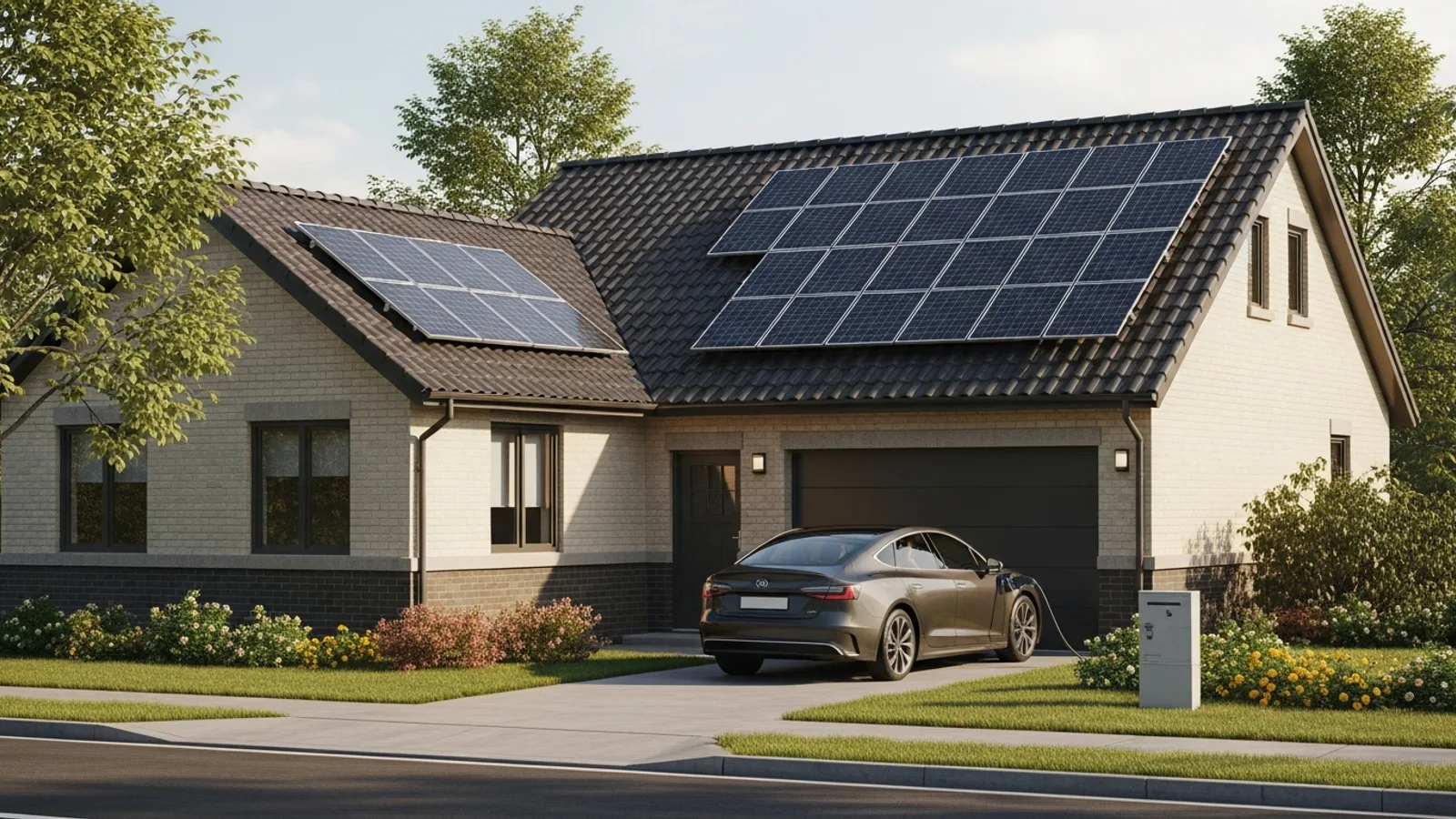
Solar Panels and an EV Charger: The Ultimate Combo
By EV Charger Directory Editorial Team
Independent EV charging research desk
Our editors research grants, hardware and installation practice across the UK, Germany and the Netherlands. We don't sell chargers or take installer commissions — the guides are funded by advertising, so the advice stays independent.
Updated: 27 June 2026
There is a particular kind of smugness reserved for the driver who fills the battery on a sunny afternoon and pays nothing for it. Pairing solar panels with a home EV charger is the closest thing to free motoring most people will ever get — but only if the two systems are set up to actually talk to each other. Bolt them together carelessly and you will still export cheap sunshine to the grid while buying expensive power back to charge at night.
Why the combination works so well
A typical home solar array produces far more power on a bright day than the house can use. That surplus normally gets exported to the grid for a modest payment. An EV, meanwhile, is a large battery on wheels that mostly sits parked during daylight hours — exactly when the panels are generating.
Line those two facts up and the logic is obvious: instead of exporting surplus solar at a low rate and buying it back later at a high one, you pour it straight into the car. The technical term is self-consumption, and raising it is where the savings live.
Surplus charging and solar diverters
The magic ingredient is a charger that can modulate its power to match whatever the panels are producing at that moment. As a cloud passes and generation drops, the charger eases off; as the sun returns, it ramps back up. This is variously called surplus charging, solar matching or eco mode, and chargers like the Zappi, Easee and several Wallbox and Ohme units offer it natively.
There are broadly three ways to run it:
- Pure surplus mode — the car only ever draws power the panels would otherwise export. Slowest, cheapest, greenest.
- Blended mode — a guaranteed minimum charge rate, topped up with whatever solar is spare. Useful if you need a certain range by morning.
- Scheduled override — ignore the sun and charge on a cheap off-peak tariff overnight, then mop up surplus the next day.
Most owners end up mixing all three across the year, leaning on solar in summer and off-peak rates in winter.
A realistic look at the numbers
Be honest with yourself about timing. A 7 kW charger wants more power than a typical domestic solar array delivers even at noon, so pure surplus charging is slow — you might add only 8–15 km of range per hour on a good day. That is fine for a car parked all day; it is useless for a quick top-up before the school run.
| Set-up | Best for | Trade-off |
|---|---|---|
| Solar surplus only | Cars parked through the day | Slow; weather-dependent |
| Solar + off-peak tariff | Most households | Needs a smart charger and tariff |
| Solar + home battery | Maximising self-use | Highest upfront cost |
Add a home battery and the picture improves again: surplus that the car cannot absorb charges the battery, which later tops up the car after dark. It is the most expensive route, but it squeezes the most value from every panel.
What the installer needs to get right
This is not a job for guesswork. The charger has to sense your import and export through a current clamp or meter, your inverter and consumer unit need to play nicely with it, and earthing and protection still have to meet standard — sunshine does not exempt you from the regulations. In Germany the wallbox still needs registering with the Netzbetreiber; in the Netherlands the picture is shifting as net-metering (salderen) is phased down, which actually strengthens the case for using solar on-site rather than exporting it.
A good installer will look at your panel capacity, your inverter, your tariff and your driving pattern together, then recommend a charger that genuinely supports surplus matching rather than one that merely claims to be "solar compatible".
Is it worth it?
If you already have solar, adding a compatible charger is close to a no-brainer — you are simply diverting energy you have already paid to generate. If you are starting from scratch, the panels make the bigger financial case on their own, with EV charging as the cream on top.
Either way, the install needs doing properly. Our directory lists certified installers who handle solar-linked charger setups, so the two systems work as one rather than as expensive strangers sharing a wall.
Frequently asked questions
- Can I charge my EV directly from solar panels?
- Yes, with a charger that supports surplus or eco charging. It senses how much solar your panels are exporting and feeds exactly that into the car, ramping up and down as generation changes. Chargers such as the Zappi, Easee and certain Ohme and Wallbox models offer this natively.
- How fast does solar-only charging add range?
- Slowly. A typical home array struggles to match a 7 kW charger, so pure surplus charging might add only 8–15 km of range per hour on a sunny day. That suits a car parked all day, but it is not enough for a fast top-up before a journey.
- Do I need a home battery as well?
- No, but it helps. Without one, surplus solar the car cannot absorb is exported. A home battery stores that surplus and later tops up the car after dark, maximising self-consumption — at the cost of a significantly higher upfront spend.
- Will the solar setup change the installation requirements?
- The core safety rules are the same: correct earthing, protection and, in Germany, registration with the network operator. The charger additionally needs a current sensor to read your import and export, and the installer must ensure your inverter and consumer unit work with it.