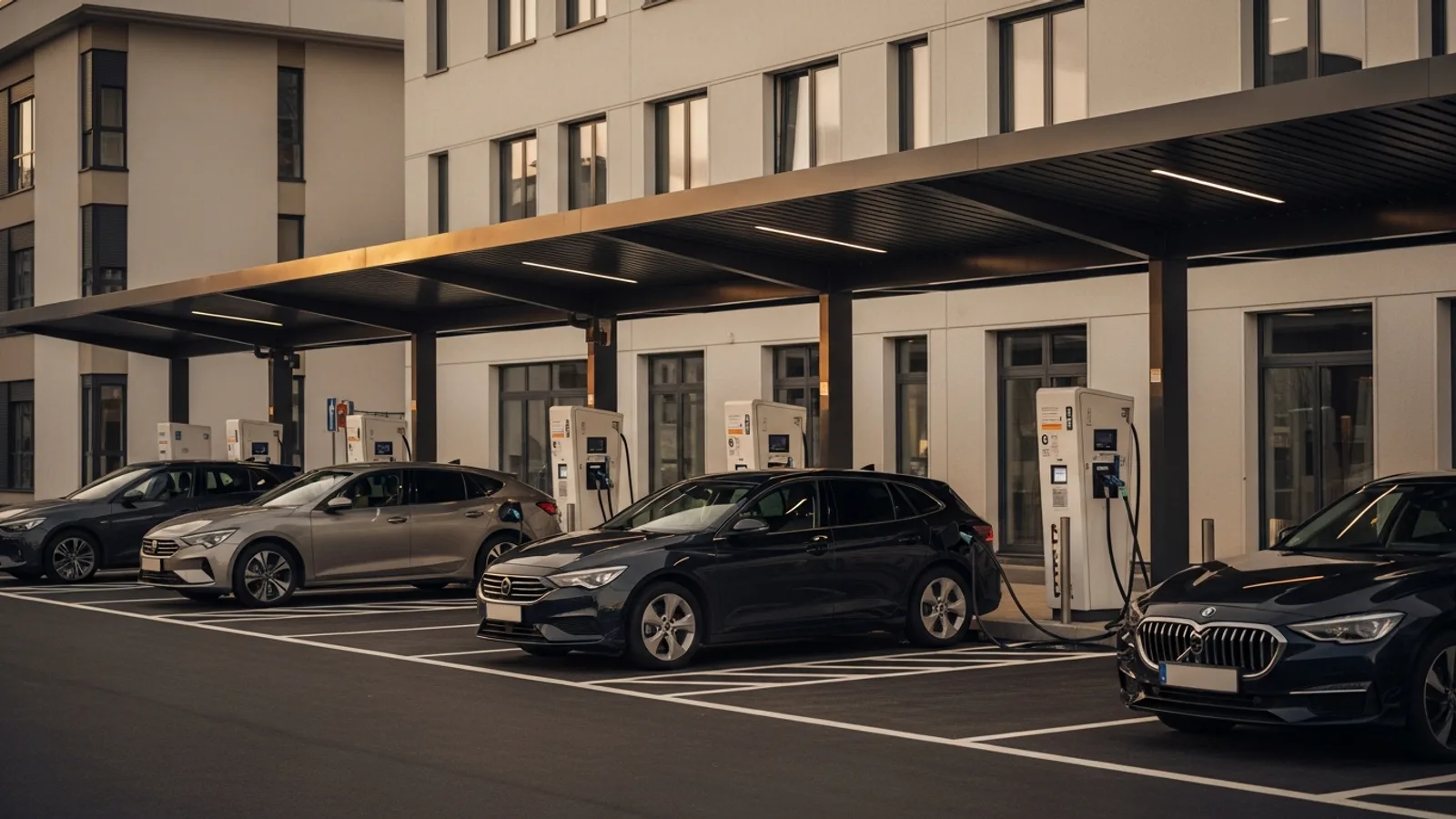
Public Charging Compared: UK vs Germany vs the Netherlands
By EV Charger Directory Editorial Team
Independent EV charging research desk
Our editors research grants, hardware and installation practice across the UK, Germany and the Netherlands. We don't sell chargers or take installer commissions — the guides are funded by advertising, so the advice stays independent.
Updated: 27 June 2026
Drive an EV from London to Amsterdam by way of Cologne and you'll meet three different charging cultures in a single day. In the Netherlands a charger is rarely more than a short walk away. In Germany the motorway corridors bristle with 300 kW ultra-rapid hubs. In the UK you'll find brilliant coverage in one town and a single broken unit in the next. Same continent, very different experience — and it matters whether you're planning a road trip or deciding if you even need to charge at home.
Where the UK stands
The UK network has grown fast, passing 75,000 public connectors and climbing, but it's uneven. London and the South East are well served; large stretches of Wales, the South West and rural Scotland are thinner. Reliability was the long-running complaint — too many dead chargers, too many apps. That's improving. New regulations now require contactless card payment on rapid chargers (50 kW and above), so you no longer need a wallet full of RFID cards or a dozen apps just to plug in.
Pricing on UK rapids typically runs £0.45–£0.85 per kWh, with slower lamppost and on-street chargers often cheaper. Ad-hoc contactless is convenient but rarely the cheapest route; subscription tariffs from the big networks shave money off if you charge away from home regularly.
Germany: the calibration-law country
Germany pairs a big network with unusually strict rules. The Ladesäulenverordnung governs how public chargers operate, and eichrecht — Germany's calibration law — means billing has to be metrologically accurate and transparent: you can verify, to the kWh, what you were charged for. Since 2023, new public chargers must also accept ad-hoc card payment without any app or contract, which has quietly fixed one of the biggest old frustrations.
Germany's strength is its HPC corridors — high-power charging hubs along the Autobahn that make long distance genuinely easy. Pricing is usually €0.40–€0.79 per kWh on fast chargers, though ad-hoc rates at premium hubs can run higher. Watch for blocking fees (Blockiergebühr) if you leave the car plugged in after it's full.
The Netherlands: density is the whole story
The Dutch network is the densest in Europe, full stop. The country is blanketed with kerbside laadpalen, and the model is genuinely clever: if you own an EV and have no driveway, you can ask your gemeente to install a public charger near your home, often on request. For the millions of residents in terraced streets and apartments without off-street parking, that's transformative.
Dutch public pricing tends to sit at €0.30–€0.65 per kWh on AC kerbside posts, with fast chargers higher. Most drivers use a single charge card (an MSP or mobility service provider) that works across networks through roaming — so one card, one bill, nationwide.
Three countries, side by side
| United Kingdom | Germany | Netherlands | |
|---|---|---|---|
| Network density | Growing, London-heavy | Large, strong HPC corridors | Densest in Europe |
| Card-free payment | Contactless on new rapids | Mandated (Ladesäulenverordnung) | Charge card + roaming standard |
| Typical public price | £0.45–£0.85/kWh | €0.40–€0.79/kWh | €0.30–€0.65/kWh |
| Billing rules | Contactless mandate | Eichrecht calibration law | MSP roaming model |
| Home supply norm | Single-phase, 7 kW | Three-phase, 11 kW | Three-phase, 11 kW |
Roaming, apps and the payment maze
The direction of travel is the same everywhere: fewer barriers. Roaming platforms let one card or app unlock chargers across multiple networks, and contactless mandates mean you can always just tap and go on newer rapids. But the cheapest option is rarely the most convenient one. A quick rule of thumb:
- Just passing through? Tap a contactless card on a rapid and accept you'll pay the ad-hoc rate.
- Charge away from home weekly? A network subscription or MSP card usually pays for itself.
- Long motorway trips? Plan around HPC hubs (strongest in Germany) and check live status before you commit.
- No driveway in the Netherlands? Request a kerbside laadpaal from your gemeente before relying on commercial fast chargers.
So why bother with a home charger?
Because in all three countries, public charging is the expensive way to fuel a car. Home electricity — especially on an overnight or EV tariff — typically costs a fraction of a public rapid. Charge at home and you wake up to a full battery every morning, with no app, no queue, no blocking fee.
The public network is for journeys, not for daily top-ups. It's the motorway services, not your kitchen. Even Dutch drivers with a charger outside their door often find a private wallbox cheaper and more predictable. A home charger is 7 kW in the UK on a typical single-phase supply, 11 kW in Germany and the Netherlands where three-phase is common — and across the board, it pays for itself faster the more you drive.
If that's the direction you're leaning, the next step is a clean, certified installation. Our directory lists vetted local installers in all three countries who hold the qualifications your network operator and insurer expect — so the home side of the equation is sorted while the public network keeps catching up.
Frequently asked questions
- Which country has the best public charging network?
- It depends what you need. The Netherlands has the densest network by far, ideal for residents without driveways. Germany has the strongest ultra-rapid HPC corridors for long trips and strict eichrecht billing accuracy. The UK is growing fast but remains regionally uneven, with the best coverage around London.
- What is the eichrecht and why does it matter?
- Eichrecht is Germany's calibration law. It requires public chargers to bill with metrologically certified accuracy, so you can verify exactly how many kWh you paid for. Combined with the Ladesäulenverordnung, it also mandates ad-hoc card payment without an app or contract on new chargers.
- How much does public charging cost per kWh?
- Rapid charging typically runs £0.45–£0.85/kWh in the UK, €0.40–€0.79/kWh in Germany and €0.30–€0.65/kWh in the Netherlands. Slower AC and kerbside posts are usually cheaper. Ad-hoc contactless rates are the most convenient but rarely the lowest; subscriptions cut the cost for regular users.
- Do I still need a home charger if public charging is everywhere?
- In most cases, yes. Home charging on an overnight tariff costs a fraction of public rapids in all three countries, and you wake up to a full battery with no apps or queues. Public networks are best for journeys, not daily top-ups — even in the dense Dutch network, a private wallbox is usually cheaper.
- Can I use one card to charge across the UK, Germany and the Netherlands?
- Increasingly, yes, through roaming. A mobility service provider (MSP) card or major network app unlocks chargers across many operators, and contactless mandates mean you can tap a bank card on newer rapids. You may still pay higher ad-hoc rates, but the days of needing a dozen RFID cards are ending.