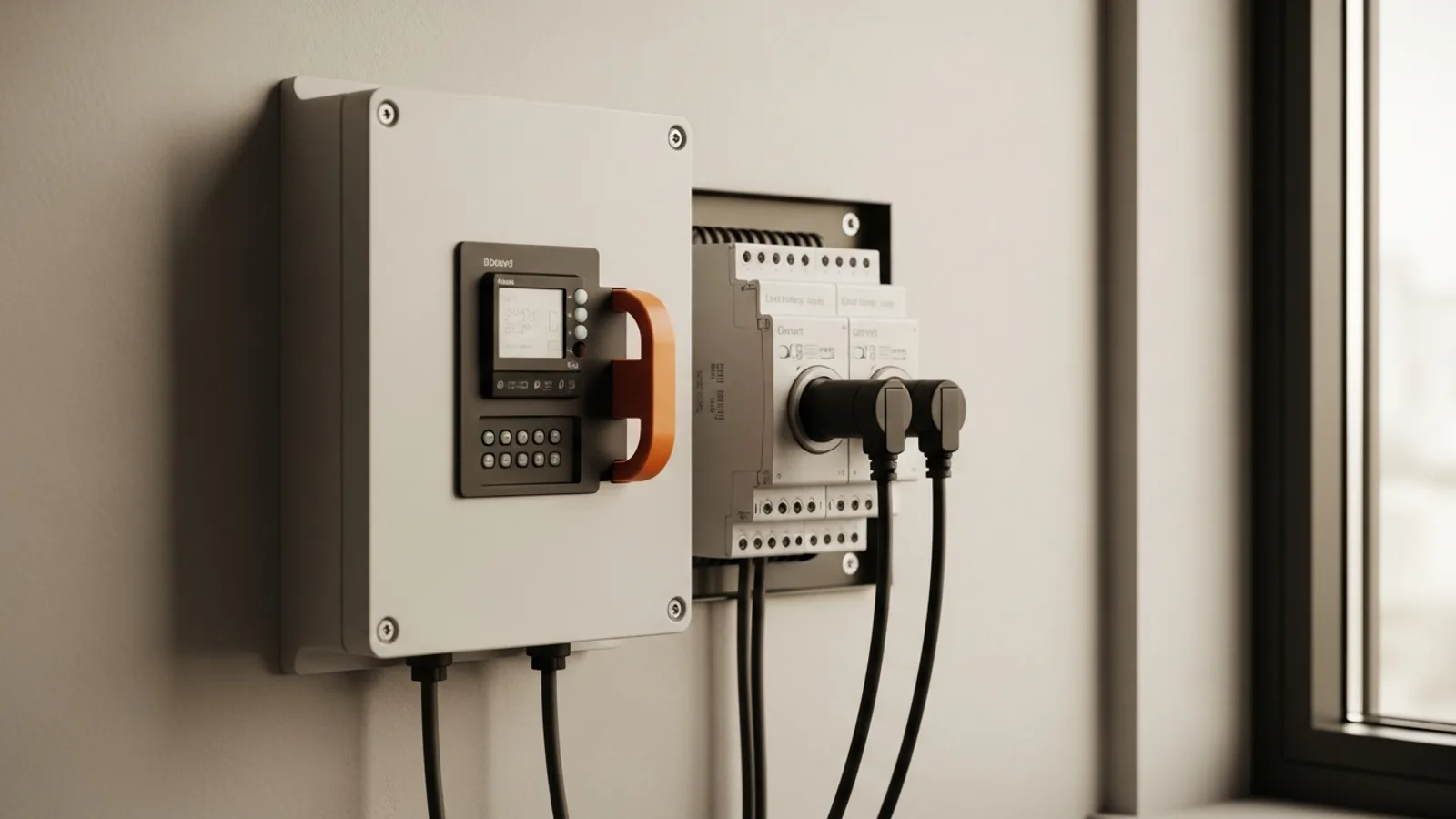
Load balancing for multiple EV chargers: explained
By EV Charger Directory Editorial Team
Independent EV charging research desk
Our editors research grants, hardware and installation practice across the UK, Germany and the Netherlands. We don't sell chargers or take installer commissions — the guides are funded by advertising, so the advice stays independent.
Updated: 27 June 2026
Add a second EV to a household and a quiet problem appears: there's only so much electricity coming through the front door. Plug two cars in alongside the oven and the immersion heater, and something has to give. Load balancing is the bit of intelligence that decides what gives — and ideally, it's never the main fuse.
Your supply is the real ceiling
Every property has a maximum the incoming supply can deliver, set by the main fuse and the size of the connection. A typical UK home sits at 60–100 A on a single phase; many newer homes in Germany and the Netherlands have a three-phase supply, which gives more headroom but is still finite.
A single 7 kW charger draws around 32 A. One charger plus normal household demand is usually fine. Add a second 7 kW charger and you can be pulling 64 A before the kettle's even on. Exceed the main fuse and it trips — and a main fuse isn't a switch you reset yourself. You wait for the network operator. Load balancing exists so you never get there.
What load balancing actually does
In plain terms, it watches how much current is flowing and tells the chargers to back off before the limit is reached. Instead of two chargers each demanding full power and overloading the supply, the system shares what's available. A car might charge at 5 kW instead of 7 kW for an hour while the dishwasher runs, then ramp back up once the house quietens down. You barely notice; the car still charges overnight.
There are two ways to do this, and the difference matters.
Static vs dynamic load management
Static load management sets a fixed cap. You tell the system the chargers can share, say, 40 A between them, and they never collectively exceed it. It's simple and cheap, but it's conservative: it reserves capacity for the rest of the house whether or not the house is using it. On a quiet night, your cars charge slower than they needed to.
Dynamic load management adds a meter on the main incomer that reads total demand in real time. Now the chargers get whatever the property isn't currently using — full speed at 2 a.m. when everything's off, throttled back at 6 p.m. when the oven's on. It costs more to install because of the metering and smarter controller, but it gets the most out of your existing supply and almost always avoids a costly supply upgrade.
| Static | Dynamic | |
|---|---|---|
| How it decides | Fixed shared limit | Reads live total demand |
| Reacts to the house | No | Yes |
| Hardware | Simple controller | Controller + main-incomer meter |
| Cost | Lower | Higher |
| Best for | Predictable, small sites | Tight supplies, busy households |
Two EVs on one supply
The most common real-world case is the two-car household. Here, dynamic management usually pays for itself by avoiding a supply upgrade — and a supply upgrade, where the network operator has to uprate your connection, can dwarf the cost of the kit. The two chargers (or one dual-socket unit) talk to each other, share the available current, and prioritise sensibly. Many systems let you set a priority car, so the one leaving at 7 a.m. gets the lion's share.
Key things a good installer will check:
- The size of your main fuse and whether the supply is single or three phase.
- Whether the chargers can communicate — same-brand units, or an open standard like OCPP.
- Where the metering clamp goes, so dynamic balancing reads true total demand.
- Whether your network operator needs to be notified or approve the combined load.
Multi-charger sites
Scale this up — an apartment car park, a small fleet yard, a workplace with six bays — and load management stops being optional and becomes the whole design. A site with eight 11 kW chargers would need a 350 A-plus connection to run them all flat out, which is rarely there and rarely worth paying for. Load balancing lets the same site run on a fraction of that, sharing power across cars that are mostly parked for hours anyway. Throughput barely suffers because few vehicles actually need full power the entire time they're plugged in.
This is also where billing and access control usually join the party, since a shared site needs to know whose energy is whose.
Getting the balance right — enough power to charge everyone, never enough to trip the supply — is exactly the kind of sizing a certified installer does day in, day out. Our directory lists installers experienced with multi-charger and load-managed sites, not just single home wallboxes.
Frequently asked questions
- What is load balancing for EV chargers?
- It's a control system that shares a property's available electrical capacity between one or more chargers so the total never exceeds the main fuse. When demand elsewhere rises, the chargers automatically draw less; when the house quietens, they ramp back up. It lets you charge without tripping or upgrading the supply.
- What's the difference between static and dynamic load management?
- Static sets a fixed limit the chargers share, reserving capacity for the rest of the house whether it's needed or not. Dynamic adds a meter on the main supply and gives the chargers whatever the property isn't using in real time. Dynamic costs more but uses your existing supply far more efficiently.
- Can I charge two EVs on one supply?
- Usually yes, with load balancing. Two chargers or a dual-socket unit share the available current and can prioritise the car that leaves first. Dynamic management often avoids the cost of upgrading your connection, which can be far more expensive than the balancing hardware itself.
- Do I need my network operator's approval?
- Often, yes — especially for higher combined power or three-phase setups. Many operators require notification or approval when total charging load rises, and in some regions a load-management system is what makes the install approvable at all. A certified installer handles this as part of the job.