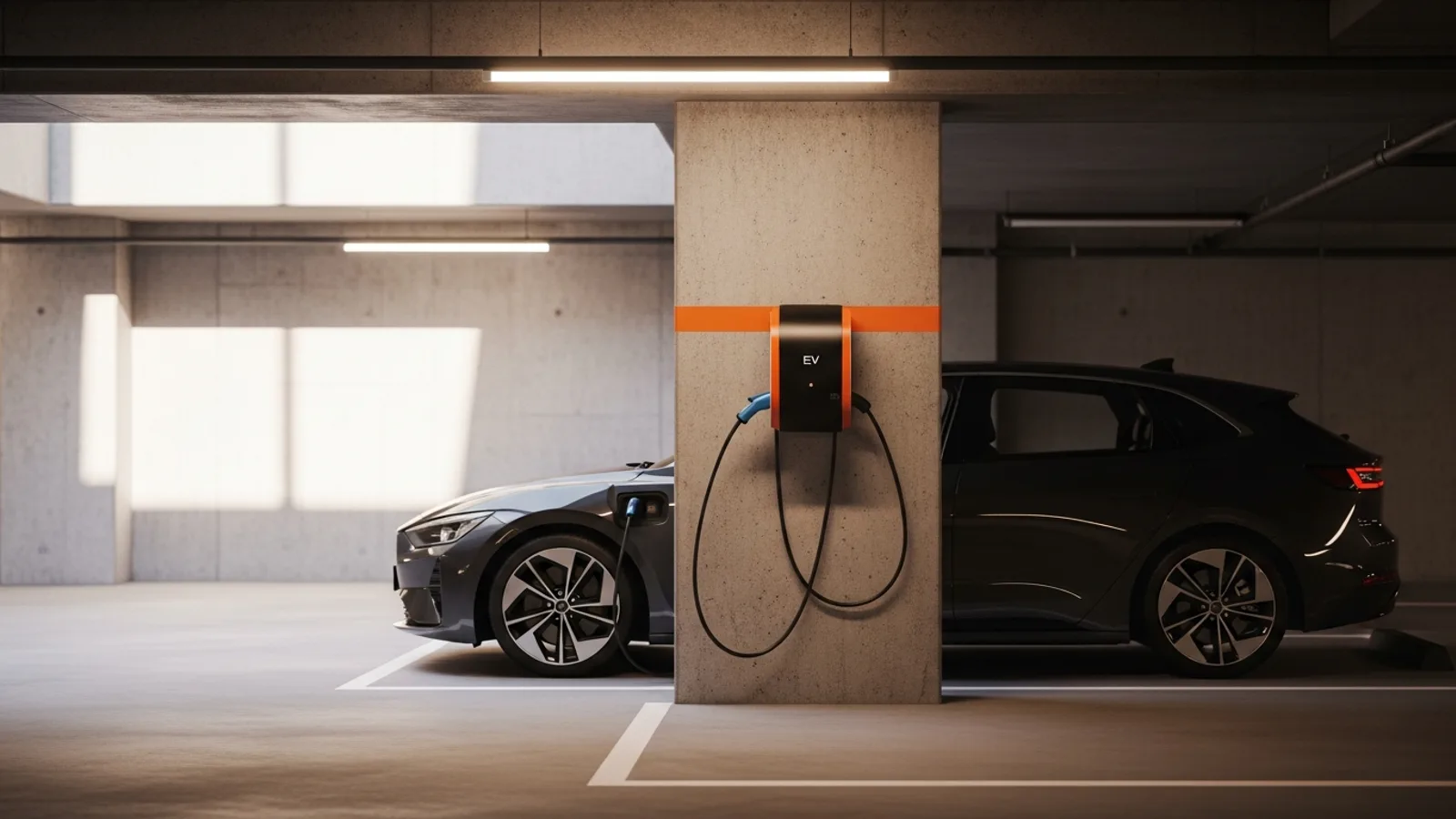
Installing an EV charger in an apartment or flat
By EV Charger Directory Editorial Team
Independent EV charging research desk
Our editors research grants, hardware and installation practice across the UK, Germany and the Netherlands. We don't sell chargers or take installer commissions — the guides are funded by advertising, so the advice stays independent.
Updated: 27 June 2026
Owning an electric car when you don't own the wall you'd bolt the charger to — that's the position millions of flat-dwellers and renters are in. A flat above a shared car park, a leasehold maisonette, a rented terrace with only on-street parking: none of these rule out home charging. Each just changes who you have to ask first.
Permission comes before hardware
Before you compare wallboxes, you need a yes from whoever controls the parking and the wall. In England and Wales, leaseholders have a stronger hand than most people realise. The lease usually governs alterations to the building, but current guidance pushes freeholders and managing agents to engage with reasonable EV requests rather than refuse them outright. You'll typically need written consent, and the freeholder can attach sensible conditions — cable routing, insurance, making good afterwards — but a blanket 'no' is increasingly hard to defend.
Renters are in a different boat. You'll need your landlord's permission, and the landlord in turn may need the freeholder's. The good news: the EV chargepoint grant was designed precisely for this, and landlords have their own version that helps cover the cost of fitting points for tenants.
Whose parking, whose wall?
The physical layout decides how hard the job is. Three common cases:
- An allocated bay next to a wall you can reach. The simplest scenario — a short cable run from your supply to a wallbox on the bay. It still needs consent, but technically it's straightforward.
- An allocated bay across a communal car park. Now the cable has to cross shared ground. That brings in the freeholder or management company, possibly a wayleave, and a conversation about who maintains the route.
- Unallocated or on-street parking. No fixed bay means no fixed charger. Here the realistic answer is often a kerbside or communal charge point requested through the council, not a private wallbox.
Cabling: the bit that gets political
In a house, a cable run is an engineering question. In a block, it's also a governance one. Armoured cable crossing a communal wall, ceiling or car-park floor touches shared property, so the freeholder gets a say in the route, the fixings and who's liable if it's ever disturbed. Good installers document this up front. The trenching or containment needed to do it neatly is often the single biggest line on an apartment quote — budget for it rather than being ambushed by it.
Metering: whose electricity is it?
This is the question that derails apartment installs more often than cabling does. Your charger has to draw from a supply that bills you, not the building. If your bay sits near your own meter, an electrician can run a dedicated circuit and you pay for exactly what you use. If the only nearby power is the communal supply, you need a separately metered connection or a smart charger with its own billing — otherwise the whole block subsidises your miles, and the managing agent will rightly object. Smart chargers with per-user authentication exist for exactly this reason, and they're standard kit on shared-parking projects.
What it tends to cost
| Your situation | Who you need onside | Likely cost on top of a standard install |
|---|---|---|
| Own bay, own wall, meter nearby | Freeholder/landlord consent | Little to none |
| Own bay, communal car park | Freeholder + possible wayleave | Longer cable, sometimes trenching — £200–£800+ |
| Communal supply, needs sub-metering | Freeholder + managing agent | Metering hardware — £300–£900+ |
| No allocated bay | Council, for a kerbside point | Usually no private cost |
The grant in brief
The EV chargepoint grant covers up to £350 of the cost of a socket for people living in rented or owned flats, with a parallel scheme for landlords fitting points across their properties. It's claimed by the installer, not by you directly, which is another reason to use an accredited one. It won't make the charger free, but on a simple flat install it can cover a meaningful slice.
A realistic path through it
Start with a short written request to your freeholder, landlord or managing agent. Name the grant, and note that you'll use a certified installer who carries insurance — that reassurance does a lot of the persuading. Get a survey before you promise anyone a figure, because the cable route and the metering decide the cost, not the wallbox on the wall. And if you're a leaseholder facing an unreasonable refusal, remember the conditions a freeholder can fairly impose are narrower than many assume.
That £350 only flows through accredited installers, and apartment work is a specialism — a domestic-only electrician often won't take it on. Our directory lists installers who do shared-parking and flat installations specifically, which is exactly the corner of the market where this gets fiddly.
Frequently asked questions
- Can my freeholder or landlord refuse an EV charger?
- They can attach reasonable conditions — cable routing, insurance, reinstatement — but a flat refusal is increasingly hard to justify for leaseholders making a sensible request. Renters need landlord consent, and the landlord may need the freeholder's. A written request naming a certified installer usually moves things along.
- Who pays for the electricity if I charge in a shared car park?
- It must come from a supply billed to you, not the building. If your bay is near your own meter, an electrician runs a dedicated circuit. If only the communal supply is reachable, you need sub-metering or a smart charger with its own billing so the block doesn't pay for your charging.
- Is there a grant for flats and renters?
- Yes. The EV chargepoint grant covers up to £350 for people in rented or owned flats, with a separate scheme for landlords. It's claimed through the installer rather than by you, so you need an accredited one. It reduces the cost rather than making the charger free.
- What if I don't have an allocated parking space?
- Without a fixed bay, a private wallbox usually isn't practical. The realistic route is a kerbside or communal charge point requested through your local council. Many authorities now take resident requests and install on-street points where demand justifies it.