How Many EV Chargers Do I Need for My Home?
By EV Charger Directory Editorial Team
Independent EV charging research desk
Our editors research grants, hardware and installation practice across the UK, Germany and the Netherlands. We don't sell chargers or take installer commissions — the guides are funded by advertising, so the advice stays independent.
Updated: 27 June 2026
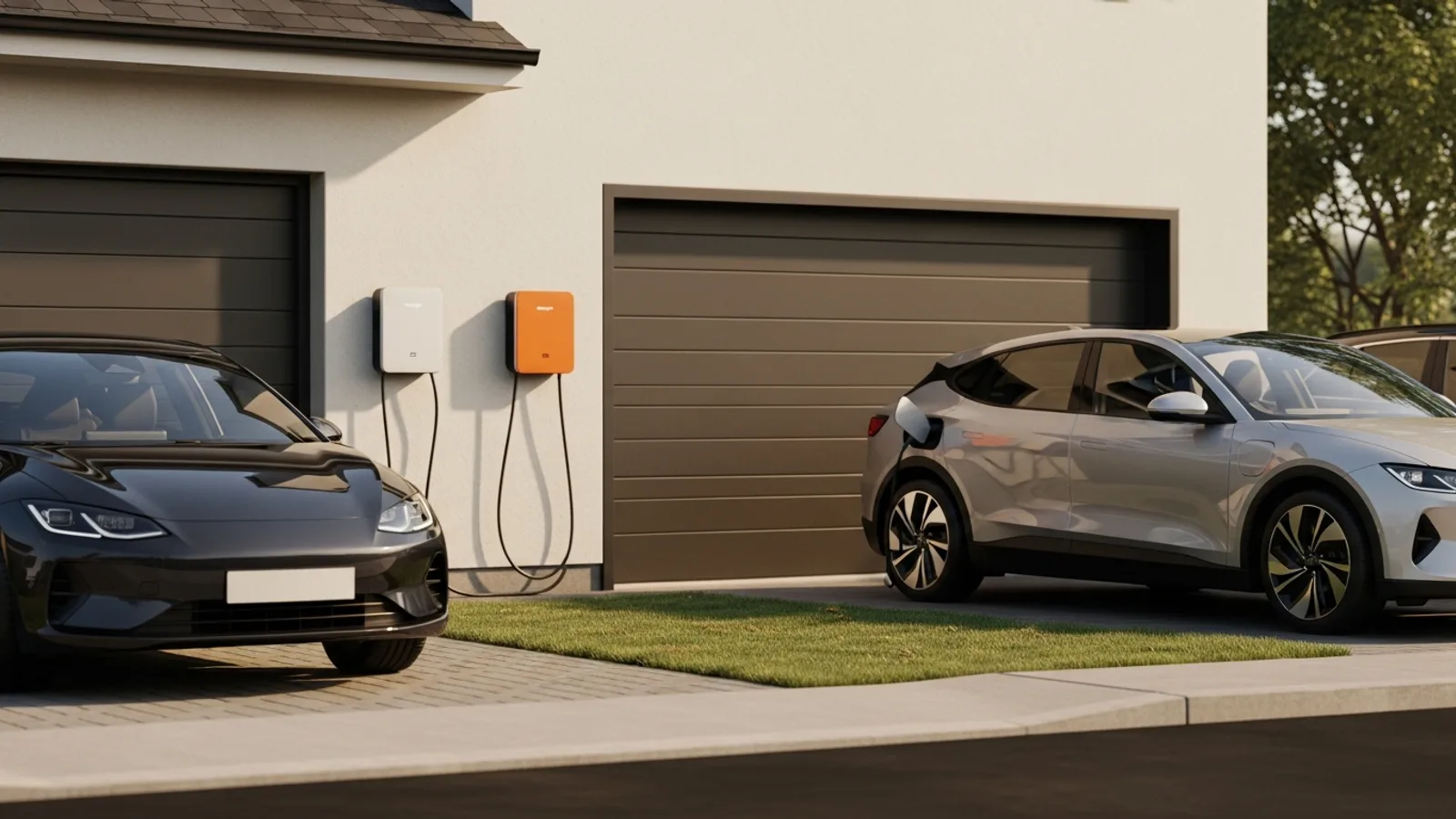
Two cars on the driveway, both electric, and the obvious worry: do you need two chargers? For the overwhelming majority of homes the answer is no — one well-chosen wallbox handles far more than people expect. But there are genuine cases where a second unit, or a smarter setup, earns its keep. Let's work out which camp you're in.
Start with how much you actually drive
The average UK driver covers around 7,000–8,000 miles a year. Spread across a week, that's roughly 30–60 miles a day for most people — call it 6–12 kWh of charge to replace.
A 7 kW charger, the UK home standard, puts back about 25–30 miles of range per hour. So even a couple of hours plugged in overnight covers a typical day's driving with room to spare. That single fact is why one charger stretches much further than the showroom maths suggests.
The people who genuinely burn through a battery every day — long-distance commuters, rural drivers, anyone doing 200+ miles between charges — are the exception, not the rule. Be honest about your real mileage rather than your worst-case week.
One charger, two cars: usually fine
Here's the scenario most two-EV households actually live in. Both cars come home in the evening, you plug one in, it's full by morning, and you swap the next night. If neither car runs near-empty every single day, alternate-night charging works and nobody notices.
A few cheap habits stretch a single charger even further:
- Charge on a schedule so the car uses your cheapest overnight window.
- Top up, don't drain — plugging in at 50% most nights beats waiting until 10%.
- Keep one tethered cable and move it between cars on the rare night both need a full charge.
For a lot of couples, that's the whole solution. No second charger, no second electrician visit.
When a second charger makes sense
Some households genuinely need two. The tell-tale signs:
- Both drivers do high mileage and regularly arrive home low — a shift worker plus a long commuter, say.
- Tight mornings, where both cars must be full by 7am with no room to alternate.
- Different cars and habits that make sharing one cable a daily nuisance.
If that's you, the good news is that adding the second point is far cheaper done at the same time as the first. Running two cables, or fitting a unit with two outlets, during the original job costs a fraction of coming back later.
The thing that makes two chargers practical: load balancing
This is the part people miss. Your home has a limited supply — a main fuse rated, in the UK, typically at 60–100 A. Two 7 kW chargers pulling hard at the same time, on top of an oven, a kettle and a heat pump, can push you past what that fuse allows.
Load balancing — sometimes called dynamic load management — solves it. The chargers talk to each other and to your meter, share the available power, and throttle back when the rest of the house is busy. It lets you run two points without paying to upgrade your supply, which is slow and expensive.
Most quality brands — Easee, Zappi, Wallbox, Alfen — support this, either across multiple units or with an add-on current sensor. Ask the installer about it specifically. It's the difference between two chargers that cooperate and two that trip your main fuse on a cold Monday morning.
A simple way to decide
| Your situation | What you probably need |
|---|---|
| One EV | One 7 kW charger |
| Two EVs, normal mileage, flexible timing | One charger, alternate nights |
| Two EVs, both high mileage or tight mornings | Two chargers with load balancing |
| A second EV arriving soon | One charger now — but run the cabling for two |
That last row is the quiet money-saver. If a second car is on the horizon, tell your installer today. Pulling an extra cable while the wall is already open costs very little; doing it as a separate job later costs a lot.
Don't forget the supply ceiling
Before committing to two high-power chargers, it's worth knowing your connection. A standard UK single-phase supply caps you near 7 kW per charger anyway, so two units will share, not double, your speed. Stepping up to three-phase to run two fast points is possible but rarely worth it for ordinary home driving.
A certified installer checks your main fuse, your consumer unit and your earthing before recommending anything — and where a supply upgrade is genuinely needed, they'll tell you straight. Our directory lists installers who do exactly that assessment in your area, so you start from facts rather than a guess.
Frequently asked questions
- Do I need two EV chargers if I have two electric cars?
- Usually not. Most two-EV households charge one car each night and alternate, which works fine unless both cars regularly arrive home nearly empty. A second charger mainly pays off when both drivers do high mileage or both cars must be full by the same early start.
- Can one charger handle two electric cars?
- Yes, for most people. A single 7 kW charger replaces a typical day's driving in a couple of hours, so alternating cars night by night keeps both topped up. Moving one tethered cable between cars covers the occasional night when both need a full charge.
- What is load balancing and why does it matter?
- Load balancing lets two chargers share your home's available power and throttle back when other appliances are running, so you don't overload the main fuse. It means you can run two charge points without paying for an expensive supply upgrade. Most quality brands support it.
- Should I prepare for a second charger now?
- If a second EV is likely within a few years, yes. Ask your installer to run cabling for two points while the wall and consumer unit are already open. Adding the cable later as a separate job costs far more than including it the first time.