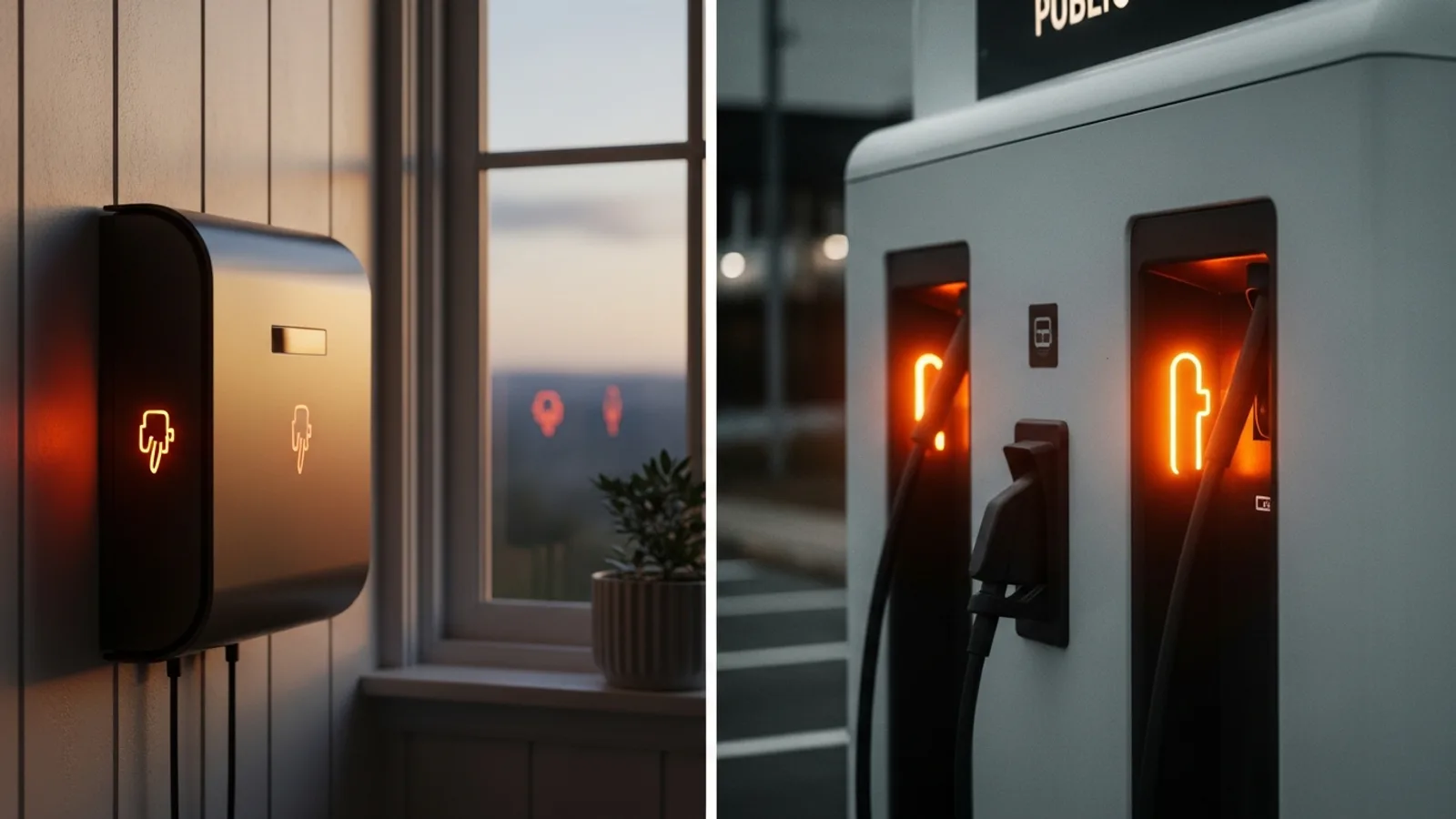
EV Charging Cost: Home vs Public Charging
By EV Charger Directory Editorial Team
Independent EV charging research desk
Our editors research grants, hardware and installation practice across the UK, Germany and the Netherlands. We don't sell chargers or take installer commissions — the guides are funded by advertising, so the advice stays independent.
Updated: 27 June 2026
Plug in at home overnight and a full battery can cost less than a takeaway coffee per 100 miles. Pull into a motorway rapid charger and the same energy can cost five or six times as much. That gap is the single biggest reason people fit a wallbox at home — so it's worth seeing the numbers side by side rather than guessing.
The three ways you'll charge
Most drivers end up using a mix of three channels, and each sits at a very different price.
- Home, off-peak. On a dedicated EV tariff, overnight electricity in the UK runs around 7–10p per kWh. This is where the savings live.
- Home, standard rate. Without a special tariff you pay your normal domestic price — currently around 25–28p per kWh under the price cap.
- Public AC (7–22 kW). Destination chargers at supermarkets, car parks and on-street posts typically cost 44–59p per kWh.
- Public DC rapid/ultra (50–350 kW). The fast stuff at motorway services lands at 70–85p per kWh, occasionally higher at peak times.
Notice that public AC isn't much cheaper than rapid in many cases — you're paying for convenience and the operator's hardware, not just the electrons.
A worked monthly example
Take a fairly typical driver covering 800 miles a month in a car that manages a real-world 4 miles per kWh. That's 200 kWh of energy a month before charging losses. Here's what that same 200 kWh costs through each channel:
| Charging channel | Price per kWh | 200 kWh / month |
|---|---|---|
| Home, off-peak EV tariff | 7p | £14 |
| Home, standard rate | 25p | £50 |
| Public AC (destination) | 50p | £100 |
| Public DC rapid | 79p | £158 |
The spread is stark. Charging entirely at home overnight costs around £14 a month; doing the same mileage exclusively on rapid chargers costs roughly £158 — more than £140 a month, or over £1,700 a year, for identical driving.
Why home charging wins (and when it doesn't)
The maths is overwhelming if you have off-street parking. Even on the standard domestic rate, home charging undercuts public AC by half and rapid by two-thirds. Move to a time-of-use EV tariff and the gap becomes almost embarrassing.
But home charging isn't free of nuance:
- No driveway, no off-peak. If you can't park where you can plug in, you're reliant on public infrastructure and the economics change completely.
- Long trips still need rapids. Nobody fits a home charger and never uses a motorway again. The realistic pattern is roughly 80–90% at home, topped up by occasional rapid sessions.
- Standing charges and tariff trade-offs. Some EV tariffs raise your daytime unit rate or daily standing charge in exchange for the cheap overnight window. If your home use is high, do the full sum, not just the headline night rate.
How the picture differs across Europe
The shape of the gap is the same everywhere, but the numbers shift with local energy prices.
| Country | Home off-peak | Home standard | Public AC | DC rapid |
|---|---|---|---|---|
| United Kingdom | 7–10p | 25–28p | 44–59p | 70–85p |
| Germany | 20–25 ct | 30–37 ct | 45–65 ct | 60–80 ct |
| Netherlands | 20–28 ct | 28–40 ct | 35–55 ct | 60–75 ct |
In Germany the spread between home and rapid is narrower than in the UK, partly because domestic electricity is expensive to begin with — but dynamic night tariffs still beat public charging comfortably. In the Netherlands, dense public AC coverage and competitive on-street pricing make public charging more viable for those without a driveway, though home still wins on cost.
The bottom line
If you can charge at home overnight, do — it's the difference between a few pounds and well over a hundred for the same month of driving. Treat public rapid charging as a tool for journeys, not a default. And if you're weighing up a home install, our directory lists certified local installers who can quote you for a wallbox that pays for itself faster than most people expect.
Frequently asked questions
- How much cheaper is home charging than public charging?
- On an off-peak EV tariff, home charging in the UK costs around 7–10p per kWh against 70–85p at public rapid chargers. For a typical 200 kWh month, that's roughly £14 at home versus £158 on rapids — a saving of well over £140 a month for the same driving.
- Is public AC charging much cheaper than rapid charging?
- Less than you'd hope. Public AC at supermarkets and on-street posts typically runs 44–59p per kWh, while rapid sits at 70–85p. You save something, but both are far more expensive than charging at home, because you're paying for the operator's hardware and convenience.
- Do I still need public charging if I have a home charger?
- Yes, for longer trips. Most home-charging drivers do 80–90% of their charging overnight and use public rapids only on motorway journeys. A home wallbox covers daily driving cheaply; rapids handle the occasional long haul.
- Does a special EV tariff always save money?
- Usually, but check the full picture. Cheap overnight rates sometimes come with a higher daytime unit rate or standing charge. If most of your household electricity is used during the day, run the complete sum rather than judging on the night rate alone.